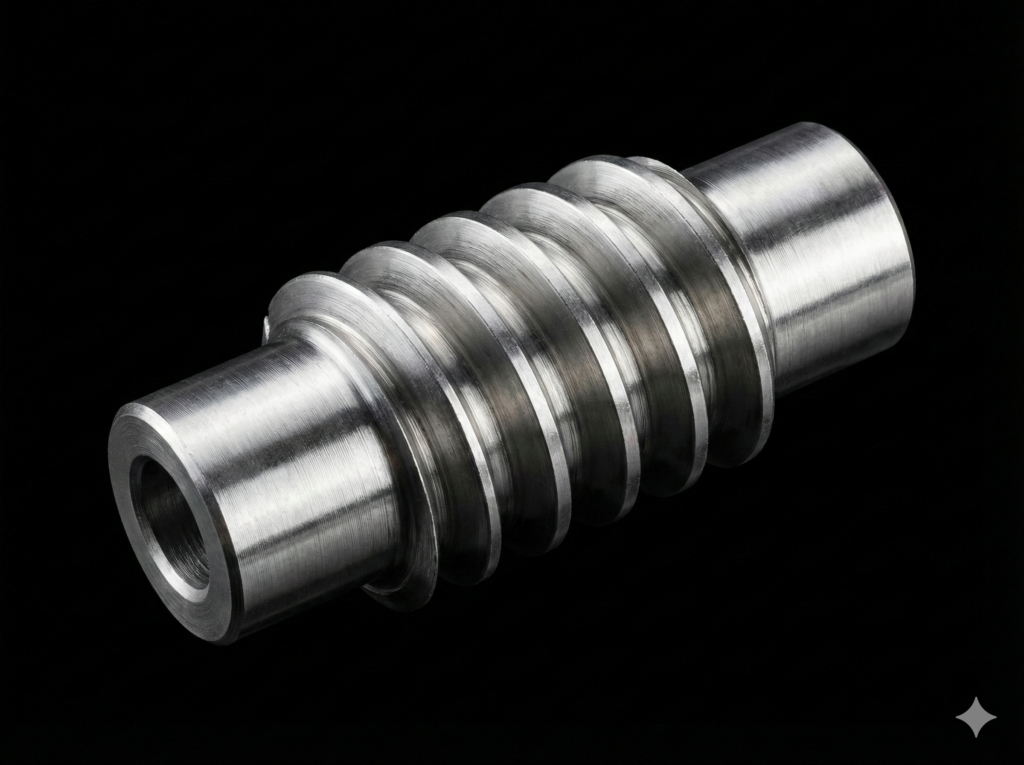
In classic spur and helical gear machining, the process is relatively straightforward: with a universal gear hob of a given module, you can cut a gear with any number of teeth. When it comes to worm gears (worm wheels), this rule no longer applies. This is because a worm gear does not mesh with a flat rack; instead, its throat wraps around the cylindrical worm.
Consequently, a worm gear hob is no longer just a universal tool—it becomes a geometric mirror image of the future worm. What criteria must the tool meet, and what manufacturing technologies allow engineers to bypass restrictive catalog requirements?
1. Perfect Fit Criteria (The Radial Feed Method)
In the traditional radial feed method (where the hob plunegs into the worm gear blank along an axis perpendicular to its rotation), the tool must replicate the geometry of the worm almost perfectly.
Three rigid rules apply here:
- Module and Pitch Consistency: The hob must have the exact same axial module and pitch as the worm.
- Outside and Pitch Diameters: The diameter of the hob should be as close as possible to the diameter of the worm. Crucially—the hob cannot be smaller than the worm. If you use a hob with a smaller diameter, the worm will physically not fit into the tooth spaces during gear assembly.
- Number of Threads (Starts): If the worm in the gearbox is double-start (two-threaded), the hob must also be double-start.
It follows clearly: to achieve the ideal, textbook profile contact, the workshop should possess a worm hob that is a 1:1 copy of the target worm (accounting for a slightly larger outside diameter to provide tip clearance).
2. Tangential Method – A Lifesaver for Single-Part Production
Investing in a dedicated, expensive worm hob for prototype production or when duplicating a single damaged gear is often economically unjustifiable. The solution to this problem is the tangential method.
This technology does not utilize a classic, long worm hob. Instead, a special single-point tool—configured in a tool holder to represent just a single tooth of the virtual worm (commonly known as a fly cutter)—is used.
How does it work? The tool is set at the target center distance of the gearbox. The machine’s feed motion does not occur radially; instead, it advances along the axis of the hob (tangentially to the worm gear being cut).
Advantage: By appropriately extending the tool bit in the holder and setting the correct angle, we can perfectly replicate the pitch diameter and profile of the mating worm using a single, inexpensive single-point tool. While the process takes significantly longer than standard generating hobbing, it ensures excellent geometric accuracy at minimal tooling costs.
3. Using a Universal Gear Hob – Acceptable, But with Caveats
Can you, therefore, use a standard, off-the-shelf gear hob intended for ordinary helical gears? Yes, but only under highly strict conditions and with full awareness of the technological consequences:
The diameter of the universal hob must be close to (slightly larger than) the diameter of the worm, and its normal module, after angular conversion, must guarantee achieving the correct axial pitch of the worm.
The Multi-Start Trap: Why a Single-Start Hob Won’t Make a Multi-Start Worm Gear
A very common and serious mistake is attempting to cut a worm gear with a universal single-start hob when the target worm in the gearbox is a double-, triple-, or quadruple-start worm.
Theoretically, by drastically increasing the swivel angle of the hobbing head on the machine, you can force the machine to cut the correct number of teeth. In practice, however, this completely distorts the tooth profile of the worm gear. The profile of a multi-start worm has a completely different helix lead angle. Gashing the wheel with a single-start hob at a steep angle will cause the contact zone between the two components to shrink from a full surface area down to a single, fragile point. Such a gearbox will wear out rapidly because the worm will essentially be operating with a standard helical gear.
Summary
Selecting the worm gear cutting method and the hob itself depends on the scale of production and the geometry you generated during the worm-turning stage.
If you have turned a precision worm with a fractional axial module on a finished basis using EvoSpline NC Generator, remember that the worm gear must match it perfectly. In the absence of a dedicated generating hob, the tangential method utilizing a simple fly cutter becomes the most predictable and reliable path to achieving the correct geometry for the entire system.