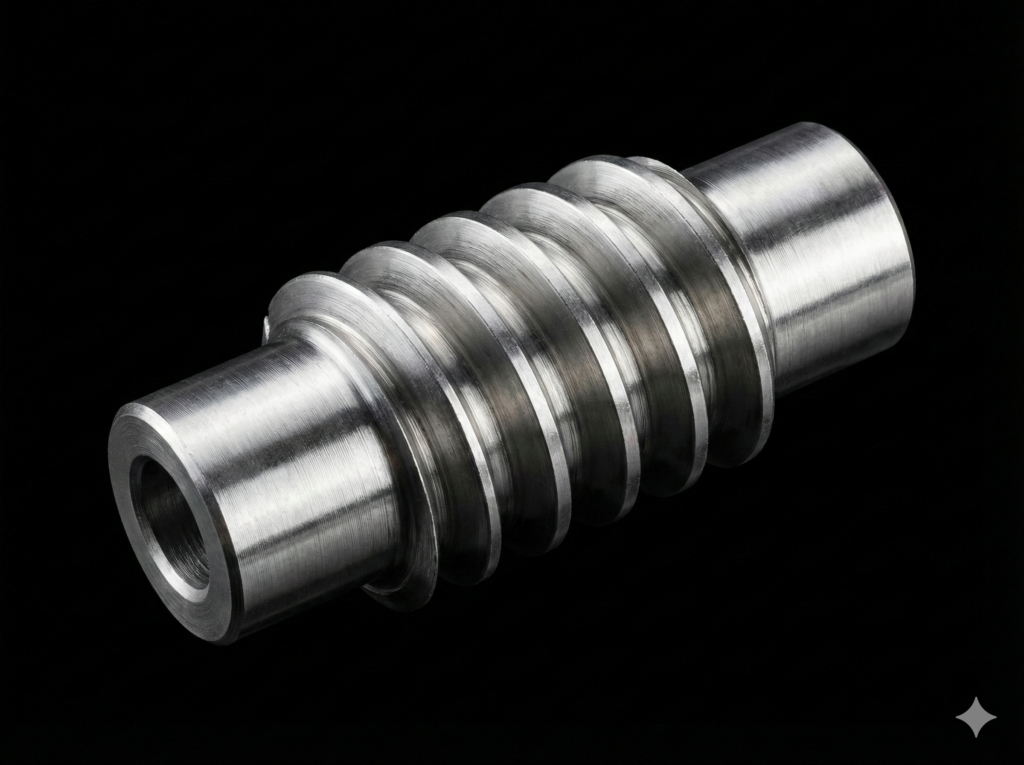
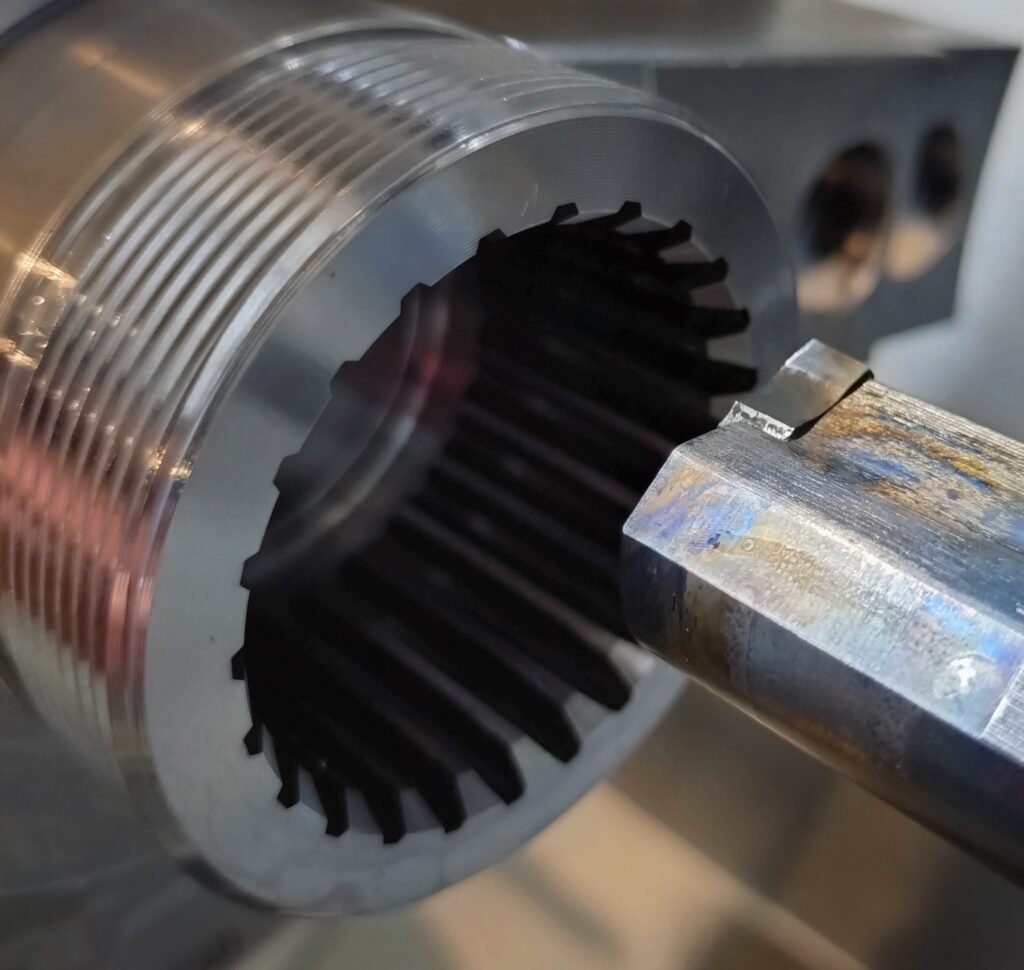
Selecting the right tooling for worm cutting on a CNC lathe is a critical phase of manufacturing process planning. Complex non-involute or involute profiles—and, in the most common case, the straight-line profile of the Archimedean worm (ZA)—present high demands for tooling engineers.
In this article, we will analyze the available options: from traditional form-cutting methods and universal indexable inserts to a modern technological approach that combines dedicated hardware with advanced software.
1. Form-Bound Tools – The Classic Approach and Its Limitations
The most intuitive method is to use a tool whose cutting edge mirrors the exact shape of the worm thread slot.
- Dedicated Form Inserts: These allow the profile to be cut in a few passes. Their main disadvantages are the high manufacturing cost (as they are often custom-made to order for a specific module) and exceptionally high cutting forces. The wide contact zone between the tool and the workpiece generates vibrations (chatter), which detrimentally affects the surface roughness.
- In-House Tool Grinding (HSS / Brazed Carbide): Many workshops still practice manual grinding of High-Speed Steel (HSS) tools or blank carbide grinds. While this is a low-budget workaround, it carries massive risks. Achieving the perfect pressure angle (typically 20°) and geometry repeatability on a standard workshop grinder is extremely difficult and time-consuming. Furthermore, such tools remain a significant challenge for larger modules, generating immense cutting resistance.
2. Non-Form Tools – Versatility That Requires Support
An alternative to expensive or difficult-to-manufacture form tools is the use of standard, readily available turning inserts. For worm cutting, machinists often attempt to adapt:
- Grooving tools (parting/grooving blades),
- Trapezoidal thread inserts,
- Rhombic inserts with a small included angle (such as VBMT or VCMT).
Using a standard insert (e.g., a VBMT with a small nose radius) offers a massive advantage: the tool is inexpensive and off-the-shelf. However, two critical technological challenges arise:
- The Necessity of Tool Tilting: With large worm leads, the lead angle of the thread slot helix is steep enough that a standard, straight-set insert will rub its clearance face against the flanks of the tooth, leading to immediate tool failure. The tool must be physically rotated (tilted) to match the helix lead angle.
- Specialized Software: A standard non-form insert cannot replicate the profile in a single pass. The geometry of the Archimedean worm must be generated using the step-over (wierszowanie / scallop) method, point by point. Machine controllers do not feature built-in cycles for such an operation—requiring external, advanced mathematical software.
3. Hardware Solution: Proprietary Adjustable Tool Holder
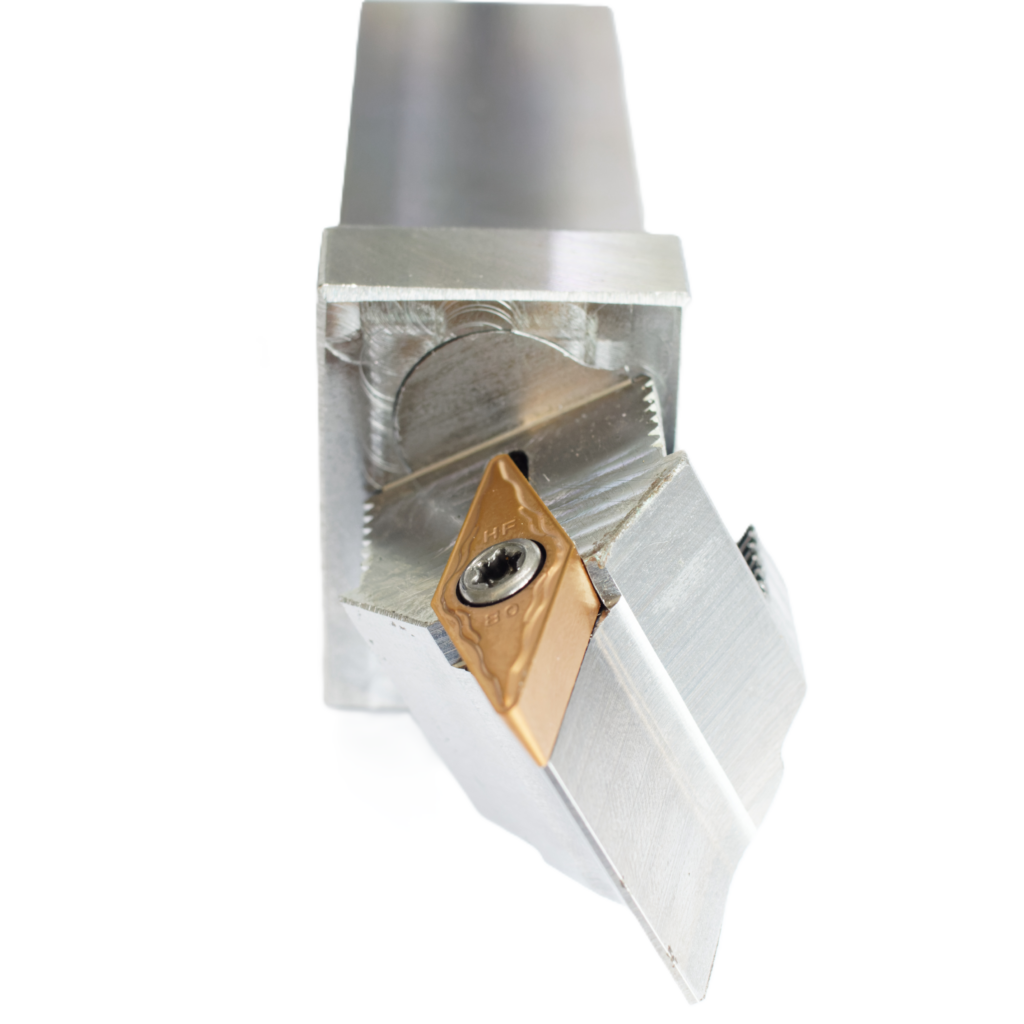
In response to the heel-rubbing and undercutting issues associated with non-form tools, a dedicated turning tool holder with an adjustable tilt angle was developed.
It resolves the fundamental kinematic challenge of helical machining by allowing a seamless adjustment of the tool’s tilt angle, adapting it perfectly to the geometry of the worm being cut. Crucially, the holder’s design ensures that the tip of the cutting insert (e.g., VBMT) always remains on the spindle center line after the angle is changed, completely eliminating the need for shimming.
4. Technological Breakthrough: The Role of EvoSpline NC Generator
The true revolution, however, lies in combining this hardware with the right algorithm. Thanks to the EvoSpline NC Generator application, the primary tooling barrier is completely removed.
Implementing this system ensures that no specialized, expensive form tooling is required to produce a fully functional, high-precision Archimedean worm.
The software handles the entire mathematical complexity of the process. Based on the basic parameters of the worm and the nose radius of any standard insert (e.g., VBMT), the application generates precise G-code for step-over machining. The software guides the universal tool in such a manner that it progressively replicates the ideal, theoretical ZA profile.
Conclusion
Choosing a tool for worm machining no longer requires a compromise between expensive, custom-ordered inserts and risky, manual grinding of HSS tools. by pairing standard non-form inserts with an adjustable tool holder and EvoSpline NC Generator software, the process becomes highly cost-effective to implement, flexible, and repeatable. The accuracy of the Archimedean worm profile is determined by a mathematical algorithm, rather than the manual skills of the operator.