Methodology and Modern Solutions
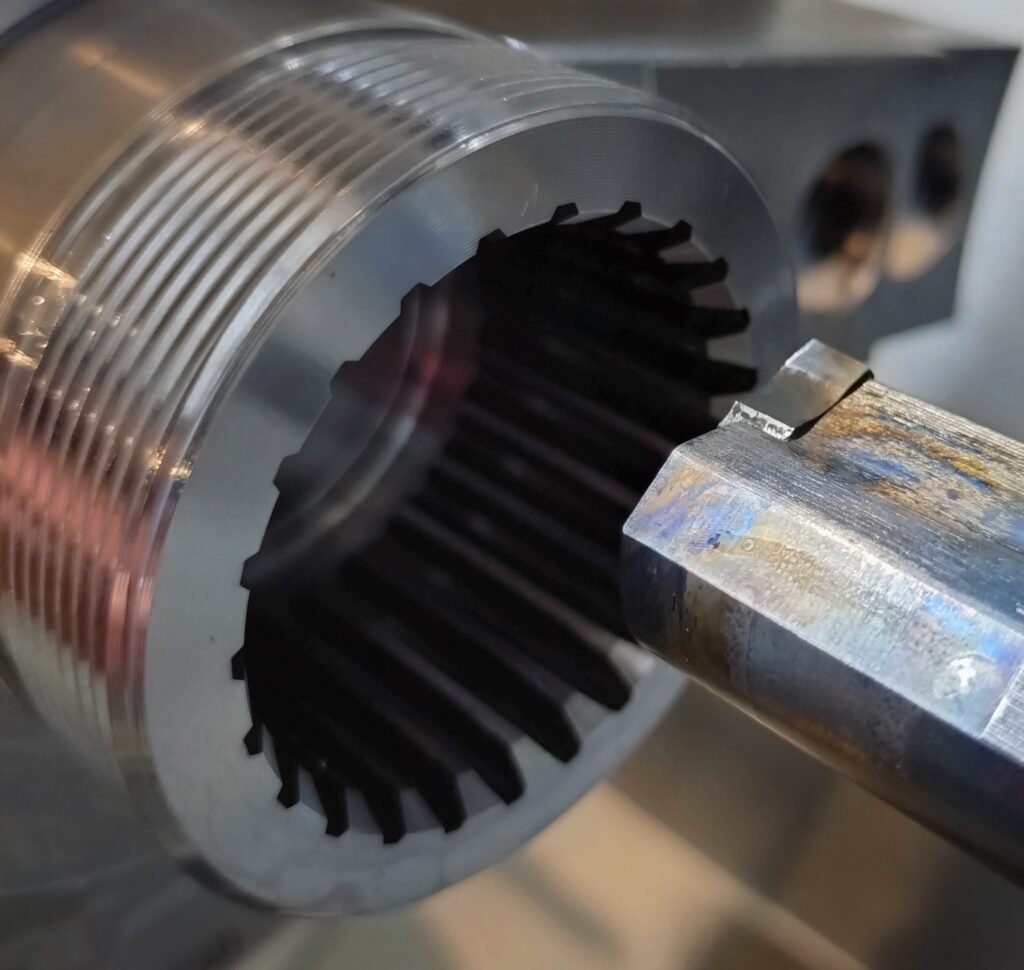
In daily workshop practice, machining a keyway or spline often requires transferring the workpiece to a milling machine or a dedicated slotter. This entails additional operational time, the need to re-datum the part, and the risk of losing concentricity. Therefore, the question often arises: can a part be slotted efficiently directly on a CNC lathe? The answer is yes. With the right technological approach, this process can yield significant time savings.
The Foundations: The Kinematics of Lathe Slotting
Fundamentally, the process of slotting on a numerically controlled lathe involves utilizing the machine in a non-traditional way. The spindle is locked in a strictly defined angular position, and the cutting motion (longitudinal) is executed solely via the machine’s Z-axis. The X-axis, meanwhile, is responsible for the radial engagement of successive material layers (depth of cut) and the tool retract after each pass.
The greatest technological challenges in this process are preventing collisions during tool retraction (especially in tight bores) and optimally dividing the material allowance into roughing and finishing passes.
A Modern Alternative: EvoSpline NC Generator – Slotting Module
To eliminate programming errors and automate complex calculations, I created the Slotting module within the EvoSpline NC Generator software. This is a dedicated tool for generating optimized EIA/ISO code for Mazak CNC lathes, completely changing the approach to writing slotting programs.
The software is designed to assist the programmer in real time. The program automatically recognizes the operation type—based on the entered Tip Diameter and Root Diameter, it determines whether the slotting is internal or external, appropriately adjusting the generated NC code and the technical helper drawings displayed on the fly.
Key Advantages and Capabilities of the Slotting Module:
- Internal Slotting Safety (Chordal Clearance): When slotting inside bores, there is a risk of the insert edge colliding with the arc of the hole. The program automatically calculates an additional safety clearance that accounts for the tool width and the hole’s chord, guaranteeing a collision-free tool return.
- Spindle Positioning Flexibility: The software supports both modern lathes equipped with a full C-axis and older machines, allowing angular positioning code to be generated using the M19 function.
- Advanced Pass Strategy: The user has full control over the depth of cut—they can set different starting and ending cut depths. The program automatically recalculates the required number of roughing passes. Additionally, it is possible to program up to 8 precise finishing passes with a defined allowance.
- Full Control Over Dynamics (G1/G0): Depending on the material and machine rigidity, the programmer can independently decide whether the cutting motions for roughing and finishing should be executed at a cutting feed rate (G1) or rapid traverse (G0).
- Splines and Angular Divisions: The program allows for the generation of a single keyway, an even distribution of any number of slots around the circumference of the part, or slotting at a strictly specified, non-standard angle.
Summary
Slotting directly on a CNC lathe eliminates the need for machine changeovers, which is crucial from a production optimization standpoint. By using the EvoSpline NC Generator software, the operator or programmer gains the confidence that the generated code accounts for all geometric pitfalls (such as the chord in internal machining) and is ready for deployment on a Mazak control, enabling fast and safe task execution.