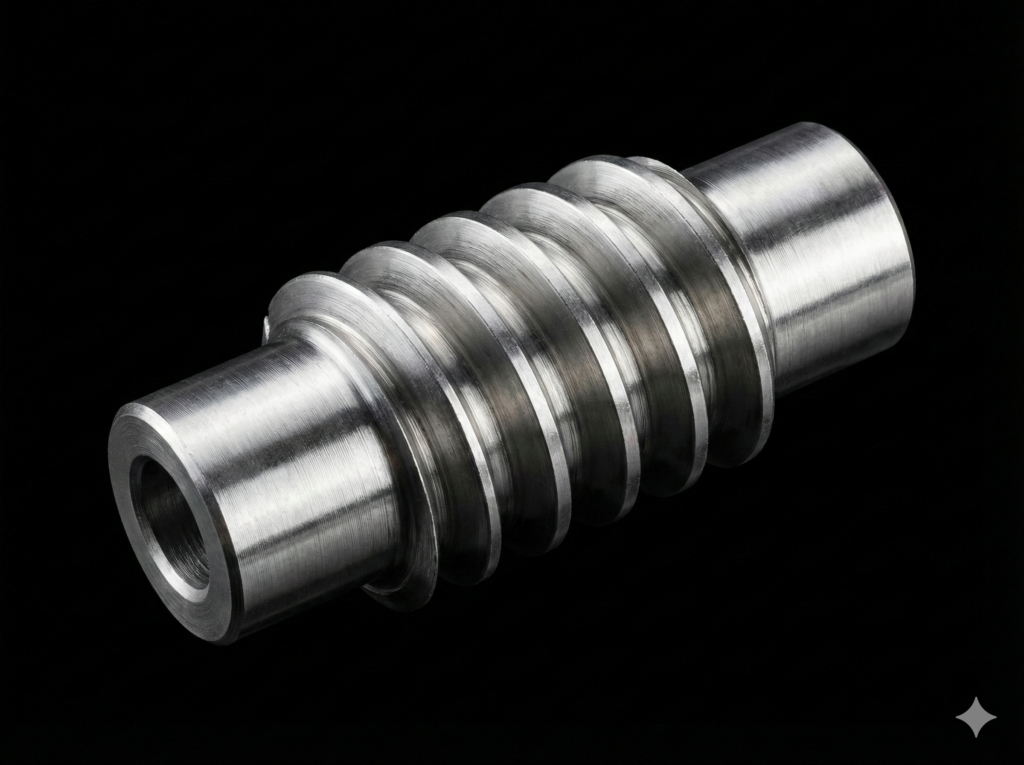
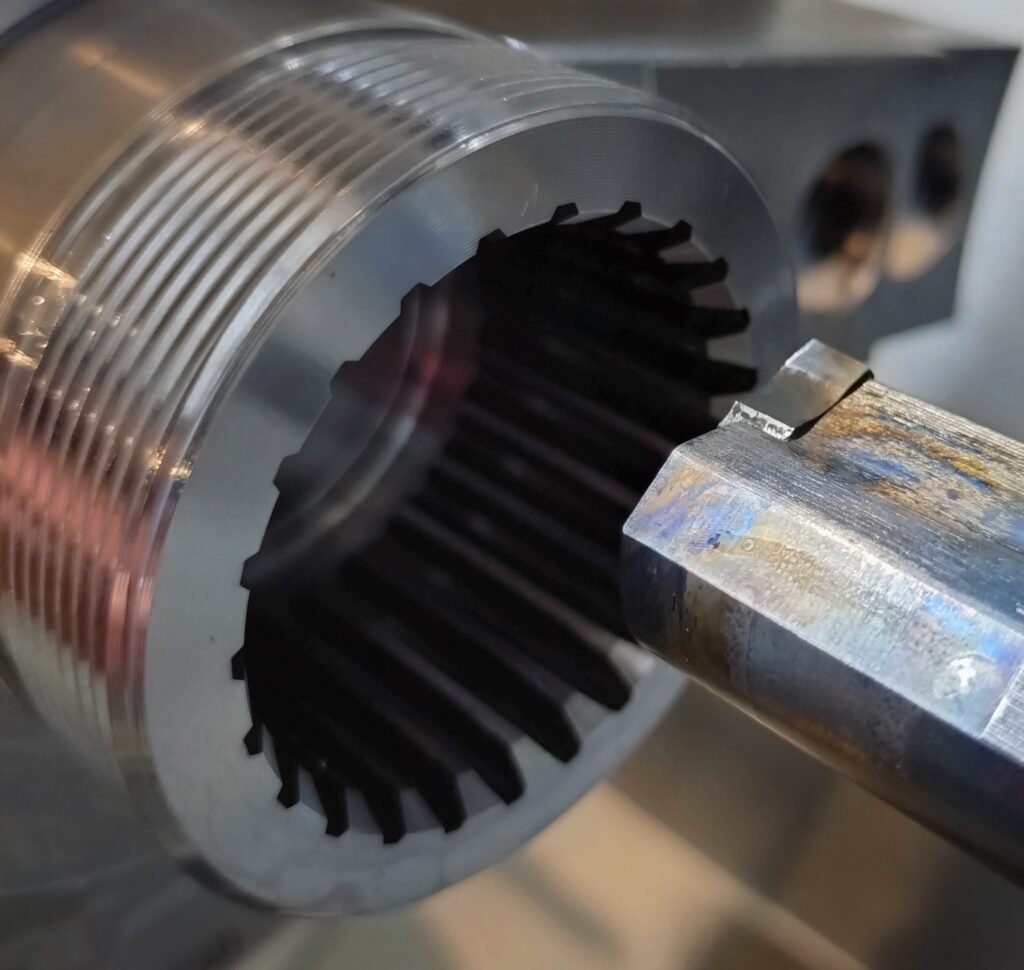
Today, cutting Archimedean worms using universal inserts and dedicated software is second nature to me. The process is repeatable, safe, and predictable. However, before reaching this stage, my manufacturing technology went down a long and bumpy road.
If you are facing worm-turning challenges today and feeling frustrated—I completely understand. I have been there myself. Here is what my workflow looked like before I developed EvoSpline NC Generator.
Stage 1: The Form Tool Era and the Constant Struggle with Geometry
In the very beginning, like most manufacturing engineers, I believed that form-cutting was the only viable way. I used traditional High-Speed Steel (HSS) tools and brazed carbide tools, which I ground manually on a workshop grinder.
It was a technological nightmare:
- The Module Problem: Every subsequent worm in the shop meant a different module. Each time, I had to grind the tool from scratch, wasting hours trying to fit the profile manually.
- Tool Life and Surface Quality: HSS tools dulled at an alarming rate, requiring constant adjustments. On the other hand, in-house ground carbide, while harder, was extremely brittle. The wide contact zone with the material generated immense cutting resistance—the tool chipped very easily, and chatter appeared on the workpiece surface.
Stage 2: The Breakthrough—A Hybrid Approach with a VBMT Insert
Tired of constant tool grinding, I decided to change my strategy. I tried a hybrid machining approach: roughing out the material using a standard tool with a rhombic VBMT insert, and finishing the profile with the existing form tool.
The result? It really got me thinking. The VBMT inserts performed exceptionally well. They allowed for high cutting speeds, their tool life was incomparably longer, and the resulting surface roughness was fully predictable and repeatable.
I then asked myself a critical question: If the VBMT handles it so well, could it be used to machine this worm in its entirety, without using a form tool for finishing?
Stage 3: The World of Parametric Macros and Its Pitfalls
To force the machine to turn a ZA profile using a universal insert, I started writing my own parametric macros. Initially, these were simple subprograms that I progressively expanded over time with additional elements and mathematical relationships.
I reached a point where I had an advanced macro template. Although it worked, daily operations with it were far from comfortable:
- Lack of Transparency: Code written at the machine controller became a long, unreadable string of variables.
- The Cost of a Single Mistake: A single minor error—a missing decimal point or a mistaken plus/minus sign—was enough to cause a severe machine collision or scrap an expensive blank.
- Inconvenient Editing: Modifying any geometric parameter on the controller screen required immense concentration and carried a high risk of human error.
This frustration became my direct inspiration. I felt the need for a tool that would encapsulate all this complex mathematics within a secure, window-based interface. That is how the idea for EvoSpline NC Generator was born.
A New Reality with EvoSpline NC Generator
When developing EvoSpline, I wanted to eliminate all the pain points I had faced on the shop floor for years. The software raised the NC code generation process to a completely new level of safety and convenience.
Key Advantages of the System:
- Utilization of Standard Tooling: No more form tools. The program automatically calculates the contact points for universal inserts (such as the aforementioned VBMT), generating a smooth step-over (scallop) machining path.
- 100% Safety (Elimination of Syntax Errors): The operator does not manually input complex mathematical formulas. You simply enter clean design parameters (module, diameters, insert nose radius), and the algorithm generates flawless, native G-code (ISO).
- Intuitive and Transparent: Instead of hundreds of lines of macro code on the machine screen, you get a clear PC graphical user interface where every variable is explicitly described.
- Optimization for Mazak Machines: The code is natively tailored to the kinematics of these machines, ensuring perfect synchronization between spindle rotation and axis feed.
- Computational Complexity: A computer program has virtually no limitations in this regard, allowing it to perform significantly more background calculations than a macro while presenting them in a highly readable format.
Conclusion
EvoSpline NC Generator was born out of real necessity and hands-on shop floor experience. Moving from manual HSS tool grinding and risky macro programming to full automation proved to me that modern CNC machining should rely on smart algorithms rather than tooling compromises. Today, I am handing that peace of mind over to other manufacturing engineers and operators.