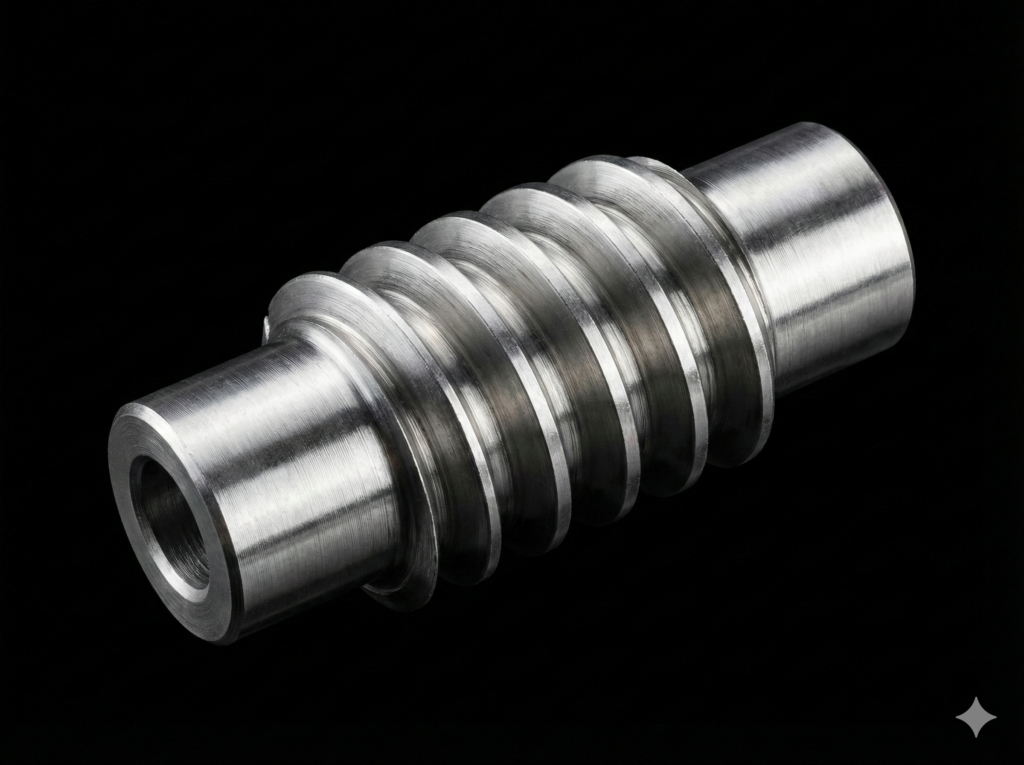
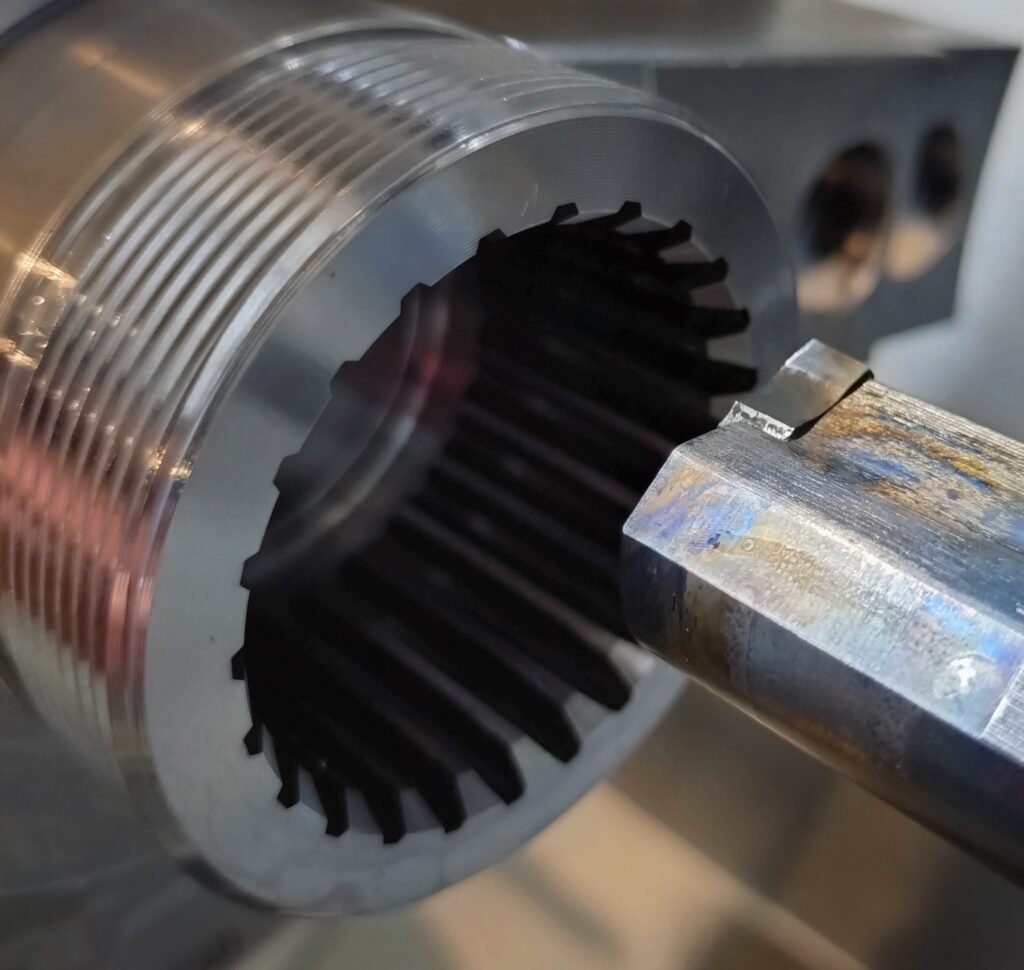
Designing and manufacturing a worm gear drive is an art of compromise, in which the material selection for the worm plays a vital role. Worms with a large module and a relatively small diameter are particularly problematic. Often, worms are designed with a low diameter factor to achieve the highest possible efficiency. However, a low diameter factor leads to a weakened load-bearing cross-section of the worm. As a result, core stresses increase, which raises the risk of fracture under load.
To make the right choice, one must first precisely diagnose the force vectors and tribological phenomena to which the worm shaft will be exposed.
1. Why is the Worm a High-Risk Component?
In classic gear drives, rolling friction dominates. In a worm gear drive, the situation is completely different – due to geometrical constraints, severe sliding friction occurs. This generates high temperatures and drastically increases the risk of accelerated wear and scuffing of the profile. These phenomena are compounded by massive mechanical loads:
- Axial loads (risk to the teeth): The longitudinal force acting on the worm starts tends to shear and break the teeth at their root.
- Radial and bending loads (risk to the shaft): The worm often constitutes a solid shaft supported by bearings. Intermesh forces tend to deflect the shaft, which, in the absence of adequate core elasticity, leads to fatigue failure.
The design conclusion is clear: a material dedicated to critical, highly loaded worms must feature high surface hardness (wear resistance) while maintaining a ductile and flexible core (resistance to fracturing under radial bending forces).
2. Economics vs. Structural Integrity
In practical engineering, there is not always a need to use the most expensive alloys. Material selection must be adequate for the intended application of the mechanism. In low-criticality applications, with low duty cycles or where minimizing manufacturing costs is the key criterion (e.g., positioning mechanisms, manual drives, simple consumer gearboxes), carbon steels such as C45 are successfully used, either in their raw state or through-hardened. This material provides sufficient properties for low torques while remaining extremely economical and easy to machine. However, when the gearbox is intended to operate continuously under full industrial load, it is necessary to switch to alloy steels subjected to quenching and tempering or thermochemical surface hardening.
3. Review of Materials and Hardening Technologies
Depending on the design requirements, steels for highly loaded worms are divided into two main technological groups:
Case-hardening Steels (High durability and scuffing resistance) This is the standard approach in machine building, allowing for the ideal compromise: a hard “shell” and a tough core.
- 16HG (16MnCr5) / 20HG: Chromium-manganese alloy steel. After the carburizing and quenching process, it achieves a surface hardness of 56–62 HRC. It features very good machinability prior to heat treatment.
- 17HNM (18CrNiMo7-6): Higher-grade structural steel with nickel and molybdenum additives. Used in gearboxes with extreme load levels. It provides higher core tensile and bending strength than classic 16HG steel.
Quenched, Tempered, and Surface-Hardened Steels
- 40HM (42CrMo4) / 40H (41Cr4): Chromium-molybdenum steels. They can be through-hardened before cutting the teeth (which increases overall strength but impairs machinability) or cut in an annealed state and surface-hardened (e.g., induction hardened) only across the thread starts.
4. The Impact of Machining Technology on Material Decisions
The choice of material determines the entire manufacturing routing on the shop floor. Utilizing through-hardened or case-hardened steels carries severe consequences: high surface hardness (above 55 HRC) means that after heat treatment, the material becomes virtually unmachinable using standard tools. The traditional process requires leaving a machining allowance, performing the hardening operation, and then undergoing the tedious and expensive grinding of the helix profile on specialized thread/worm grinding machines. This is because every hardening process introduces thermal distortions that warp the tooth geometry.
Modern nitriding techniques (such as plasma nitriding) serve as an alternative, achieving high surface hardness at significantly lower process temperatures, thereby minimizing distortion. However, regardless of the chosen path, the critical question remains: how to prepare the worm profile before or after heat treatment to maintain a perfect geometry without generating astronomical tooling costs?