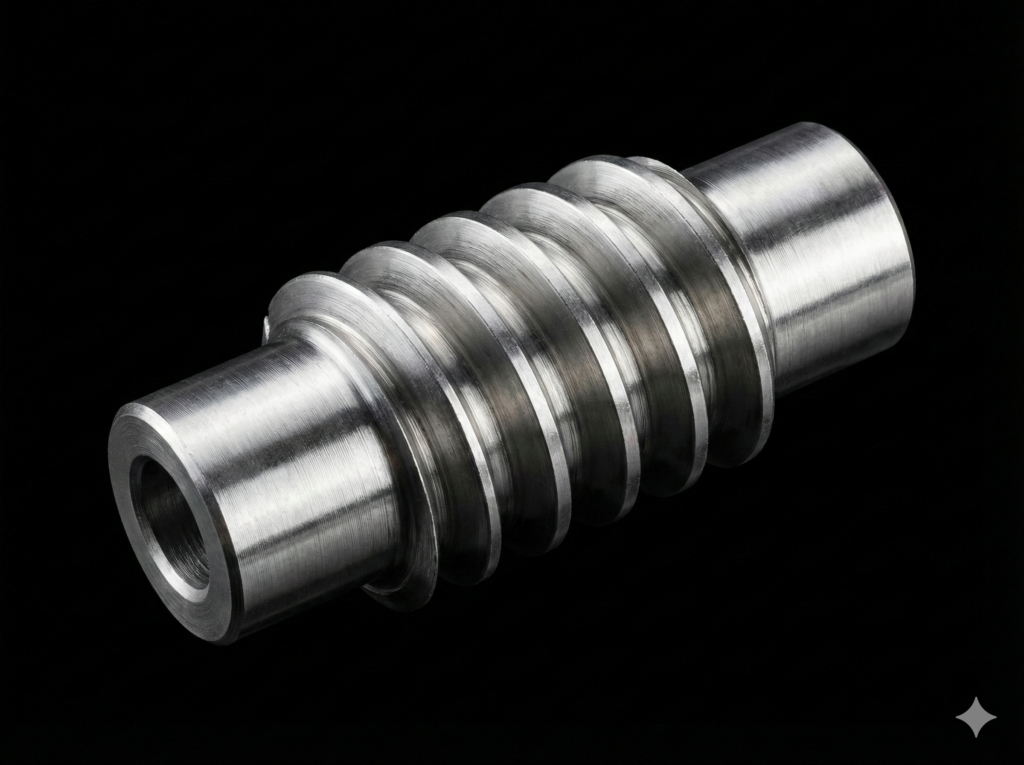
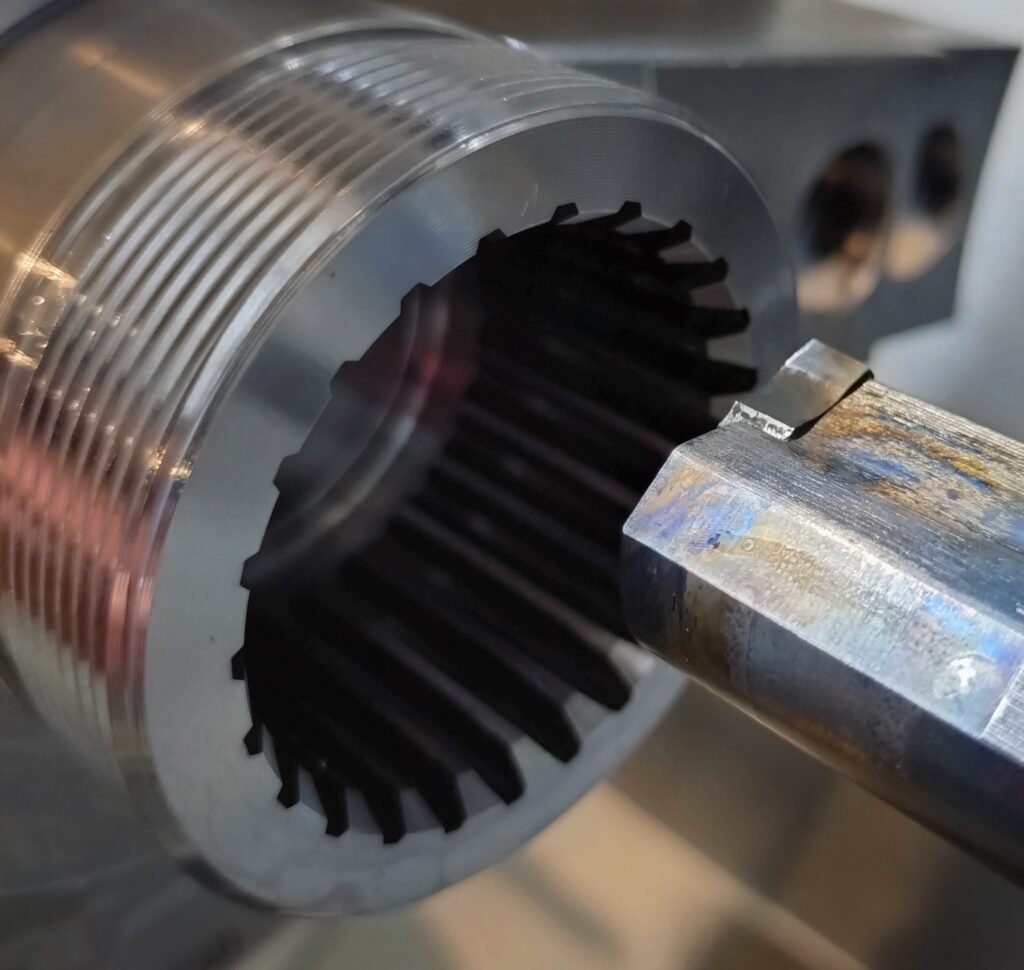
When you ask an experienced machinist what tool to use to manufacture an Archimedean worm (ZA) with a module of 4 or 6, most will point without hesitation to a form tool—either high-speed steel (HSS) or an expensive, dedicated carbide insert custom-made for that specific module. But what if I told you that you can successfully machine that exact same precise profile using a standard, widely available rhombic VBMT 1604.. insert with a 35° included angle? To many manufacturing technologists, this sounds like science fiction. However, in modern CNC machining, it is not only entirely possible but often far more efficient and economical. How does it work, and what conditions must be met?
1. Why Specifically the VBMT Insert?
The VBMT insert (or its single-sided version, VCMT) is an absolute staple in any CNC machine shop, used daily for profiling, undercutting, and finishing. Its unique geometry offers massive advantages when cutting tough, heavy profiles:
- Minimal Contact Area: Unlike form tools that cut across the entire width of the groove, a VBMT insert engages the material with only a small portion of its nose radius (typically 0.4 mm or 0.8 mm). This results in a drastic reduction in cutting forces and completely eliminates chatter, even on large worm modules.
- Hard Turning: Modern carbide grades with PVD/CVD coatings on VBMT inserts easily handle pre-hardened steels up to 45 or even 55 HRC (e.g., 40HM/42CrMo4, tool steels, or spring steels).
2. Two Technical Conditions: How to Make a VBMT Cut a Worm
A VBMT insert placed in a standard turning tool holder cannot machine a worm on its own. For the process to succeed, we must solve one physical problem and one mathematical problem.
- Condition 1: Physical (Proper Tool Tilting) When cutting a helix with a large lead, the lead angle of the groove is very steep. If you were to use a standard tool holder, the insert’s clearance face would rub against the flanks of the worm tooth, causing instant failure of the cutting edge.
- The Solution: The tool must be tilted to match the helix lead angle of the worm. This technology utilizes special adjustable tool holders that allow for smooth angle regulation. The crucial factor here is the design of the holder—after adjusting the angle, the tip of the VBMT insert must remain perfectly on the spindle centerline, eliminating the need for shims or tedious multi-axis setup.
- Condition 2: Mathematical (Step-over Turning Technology) A non-form-style insert cannot replicate a tooth profile in a single pass. The Archimedean worm profile (which is straight-lined in the axial cross-section) must be generated using the step-over method. The tool executes dozens of precise passes, sculpting the theoretical tooth profile point by point.
3. The Role of EvoSpline NC Generator – The Brains of the Operation
Writing a step-over program for a worm using a VBMT insert directly at the machine control (whether via conversational systems like Mazatrol or manually in ISO G-code) is extremely difficult and time-consuming. The code becomes a massive, unreadable string of mathematical variables, and a single decimal point error can cause a major crash. This is where the EvoSpline NC Generator application plays a critical role. The software takes care of all the mathematical complexity of the process. You only need to input the standard design data of the worm (module or lead, diameters) and the nose radius of your VBMT insert. The application’s algorithm automatically calculates the tool path trajectory and generates clean G-code optimized for the kinematics of Mazak machines. Thanks to the advanced computing, the step-over increment is so tight and fluid that the part comes off the machine with the target surface finish and perfect tooth geometry, completely bypassing the grinding operation.
Summary: Is It Worth Moving Away from Form Tools?
The answer is: Absolutely yes. Utilizing a universal VBMT insert paired with EvoSpline NC Generator software brings enormous benefits:
- Economy: You don’t need to purchase expensive, custom-ordered profile inserts for every module. You work with inexpensive, standard inserts that you already have in stock.
- Finish Machining: You can turn pre-hardened material (up to 55 HRC) or nitriding steel, eliminating heat-treat distortion and the need for secondary grinding.
- No Chatter: The point-contact of the insert with the material allows for stable cutting even in very deep grooves with large modules.
Step-over technology proves that a universal tool driven by a smart algorithm can easily outperform specialized, expensive tooling systems.