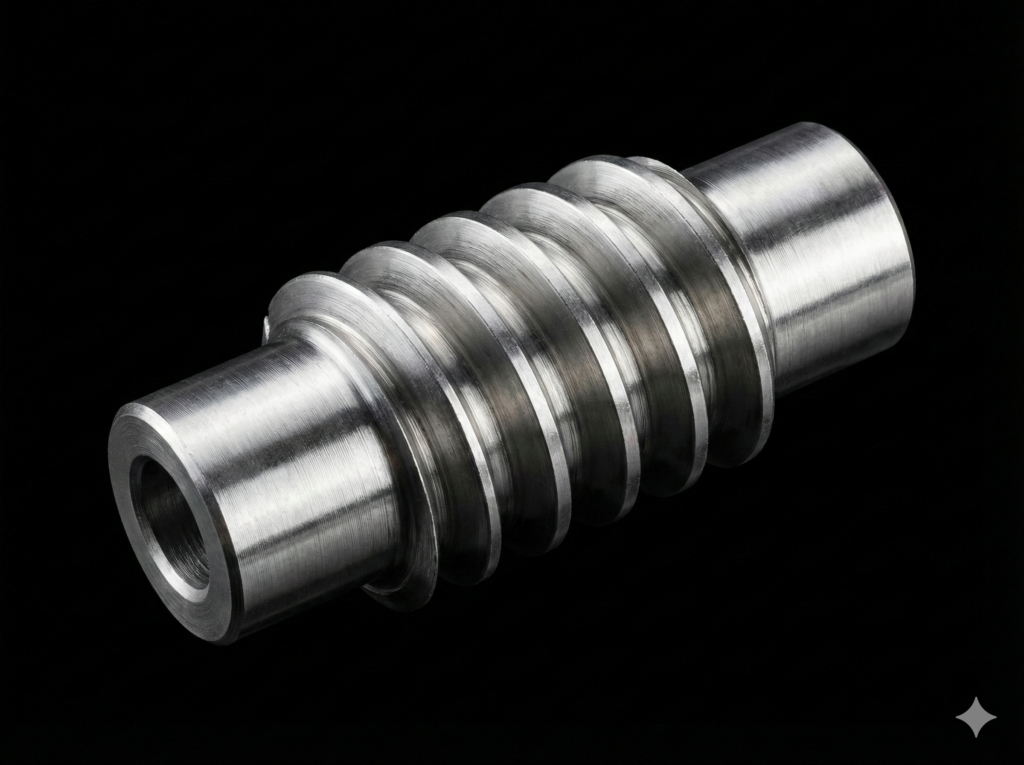
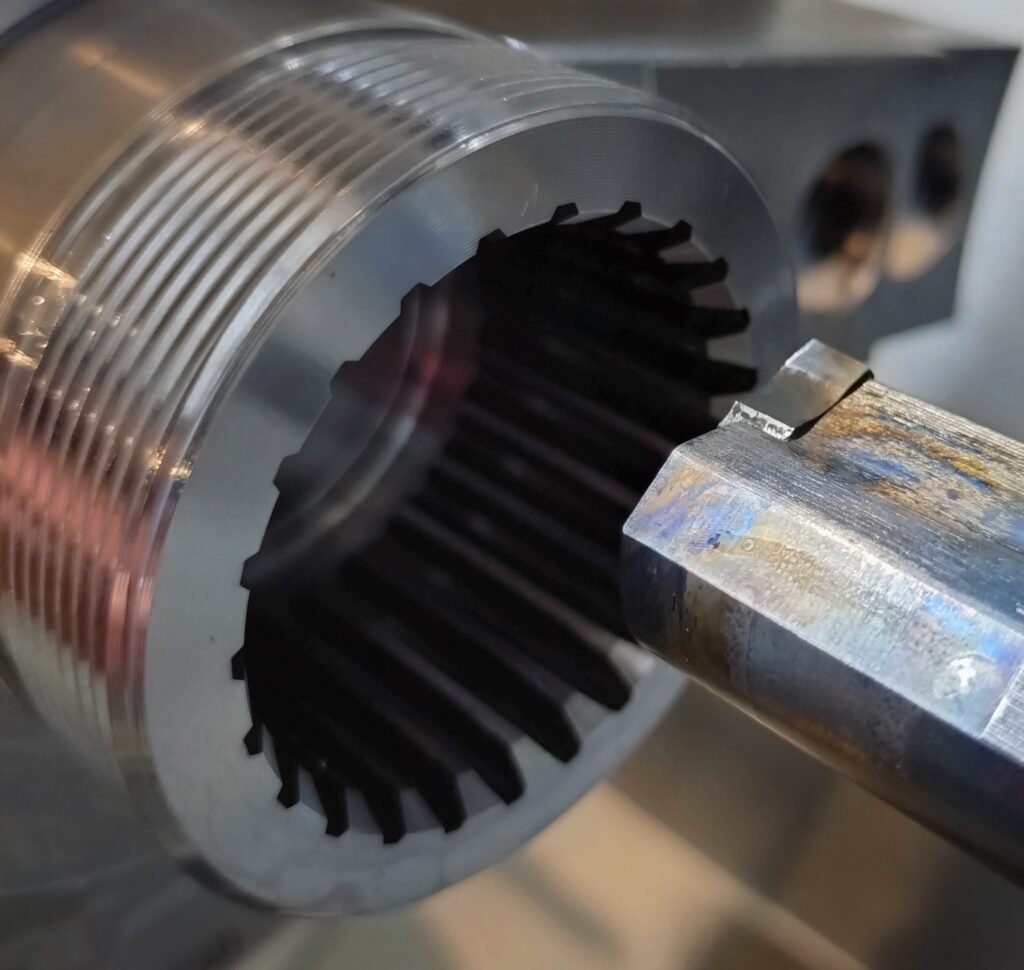
Manufacturing a worm shaft that is ready for gearbox assembly straight off the CNC lathe (or requires only low-temperature nitriding) is a technological milestone for any machine shop. It completely eliminates the need for a subsequent thread-grinding operation.
However, for this process to be successful, three key pillars must be synchronized: the proper material, the correct tool geometry, and a flawless tool path generated by EvoSpline NC Generator.
1. The Foundation of the Process: Material Selection and Heat Treatment
Material selection depends on the target hardening strategy and the intended application of the gearbox:
- Quenched and Tempered Steels: Steels like C45 or 40H (41Cr4) are pre-hardened to 40–45 HRC before cutting the teeth. After the turning operation, the part maintains perfect geometry and goes straight to assembly.
- Nitriding Steels: The material (e.g., 38HMJ / 41CrAlMo7-10) is pre-hardened to 35–40 HRC, finish-turned, and then subjected to nitriding. Since this process occurs at low temperatures, the surface layer gains high hardness while the worm suffers no thermal distortion.
Technological Tip: Free-cutting Versions (With Added Sulfur)
Regardless of the chosen path, selecting a free-cutting version of the steel (with controlled, elevated sulfur content) is highly advantageous. The presence of sulfur in the alloy drastically improves chip-breaking, reduces cutting forces, and yields a significantly lower surface roughness—which is critical during the finish machining of the profile.
2. Hard Turning and Step-over Machining – The Modern Alternative
Traditional machine-shop thinking dictates that material with a hardness above 40 HRC is “too hard for finish profiling.” This is a myth left over from the high-speed steel (HSS) era.
Modern, universal carbide inserts (such as rhombic VBMT or VCMT) featuring advanced PVD/CVD coatings easily handle the turning of materials ranging from 45 to even 55 HRC.
The key lies in utilizing the step-over turning technology implemented by the EvoSpline software:
- Ideal Shape and Roughness: The application precisely calculates the contact points between the insert tip radius and the theoretical Archimedean worm profile. A properly selected, micro-step increment yields a tooth flank finish comparable to a ground surface.
- Versatility with High Leads: For worms with large helix angles, step-over machining combined with an adjustable tool holder becomes the most versatile and efficient manufacturing method—especially for large modules.
3. The Form-Tool Method – Why It Loses in Modern Machining
To fully appreciate the advantages of step-over machining with EvoSpline, it is worth comparing it to traditional cutting methods that utilize full-profile form tools.
HSS Form Tools
High-speed steel (HSS) tools are relatively cheap to prepare and can achieve quite a good surface finish in soft materials. However, their physics exclude them from efficient production:
- They require very low cutting speeds and minimal depths of cut. The process is slow.
- They are completely useless when machining pre-hardened materials (above 40 HRC)—the cutting edge dulls instantly.
Carbide Form Tools
The introduction of full-profile carbide indexable inserts aimed to solve the hardness issue but generated new barriers:
- High Cost: Dedicated form inserts for a specific module and profile are very expensive.
- Vibration and Chatter: When cutting with a full profile (especially with larger modules), the contact area between the edge and the material is massive. This generates enormous cutting forces and chatter, which ruins the part’s surface finish and causes the insert edge to micro-chip. To prevent this, the operator must drastically reduce the cutting speed, which completely negates the carbide advantage.
Summary
| Machining Feature | Traditional Form Tools | Step-over Machining with EvoSpline (VBMT Insert) |
| Tool Availability and Cost | Expensive custom-order carbide or tedious HSS sharpening | Cheap, universal, and widely available standard insert |
| Risk of Chatter/Vibrations | High | Low |
| Efficiency on Large Modules | Low / Medium | High |
| Max Material Hardness | < 30 HRC (for HSS); limited stability for carbide | 45 – 55 HRC |
Combining free-cutting pre-hardened or nitriding steels with the step-over algorithm in EvoSpline NC Generator completely redefines the worm manufacturing process. Shifting the difficulty of profiling from a physical, expensive form tool to a precise G-code path allows for the fast, predictable, and cost-effective production of precision gear drives.